Introducing draft pull requests
You can now use draft pull requests to clearly tag when you’re coding a work in progress.
At GitHub, we’ve always felt that you should be able to open a pull request to start a conversation with your collaborators as soon as your brilliant idea or code is ready to take shape. Even if you end up closing the pull request for something else, or refactoring the code entirely, a good pull request is as much about collaboration as it is about code.
But what if you want to signal that a pull request is just the start of the conversation and your code isn’t in any state to be judged? Perhaps the code is for a hackathon project. You have no intention of ever merging it, but you’d still like people to check it out locally and give you feedback. Or perhaps you’ve opened a pull request without any code at all in order to get the discussion started.
Tag your work in progress
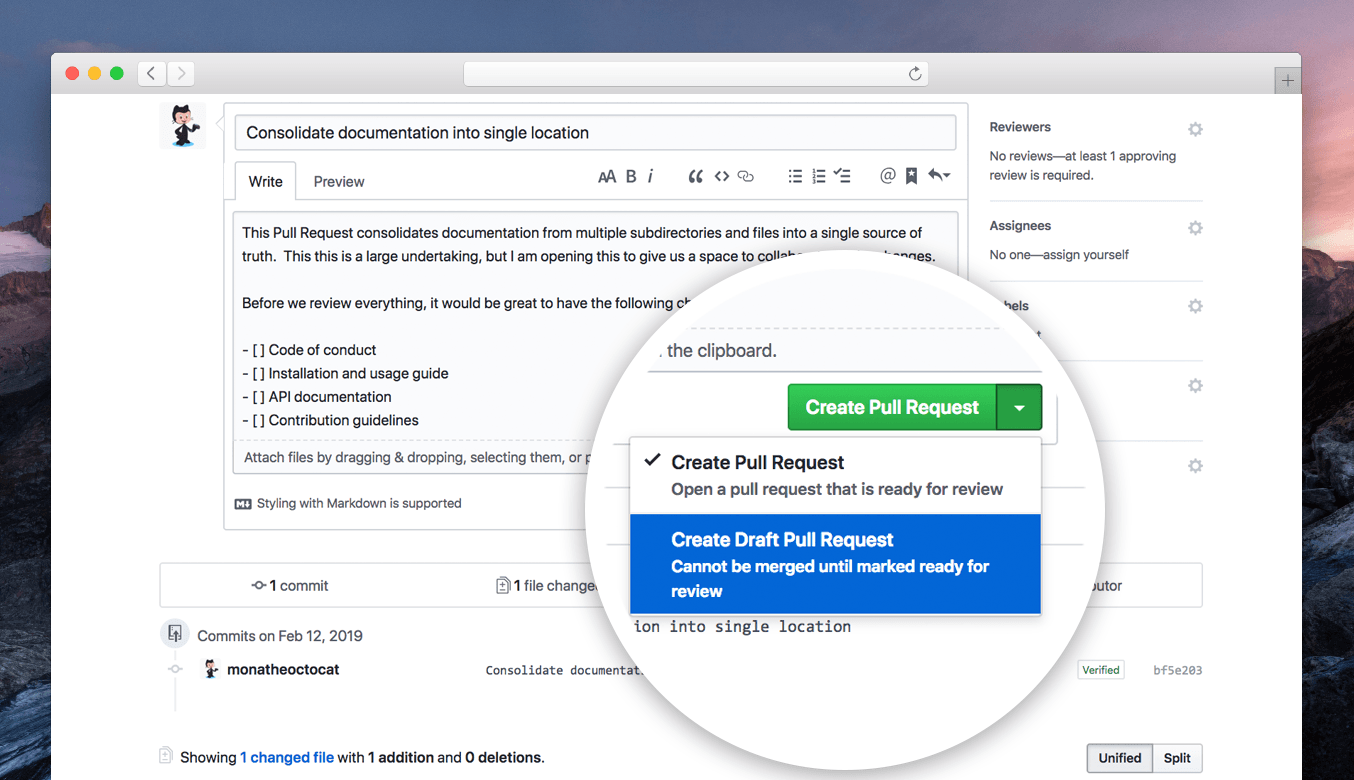
With draft pull requests, you can clearly tag when you’re coding a work in progress. Now when you open a pull request, a dropdown arrow appears next to the “Create pull request” button. Toggle the dropdown arrow whenever you want to create a draft instead.

A draft pull request is styled differently to clearly indicate that it’s in a draft state. Merging is blocked in draft pull requests. Change the status to “Ready for review” near the bottom of your pull request to remove the draft state and allow merging according to your project’s settings. Also, if you have a CODEOWNERS file in your repository, a draft pull request will suppress notifications to those reviewers until it is marked as ready for review.
Get started
Draft pull requests are ready for your code in public and open source repositories, as well as in private repositories for groups using GitHub Team and Enterprise Cloud.
Learn more about draft pull requests
Tags:
Written by

Related posts

What’s coming to our GitHub Actions 2026 security roadmap
A look at GitHub Actions’ 2026 roadmap, outlining how secure defaults, policy controls, and CI/CD observability harden the software supply chain end to end.

Updates to GitHub Copilot interaction data usage policy
From April 24 onward, interaction data—specifically inputs, outputs, code snippets, and associated context—from Copilot Free, Pro, and Pro+ users will be used to train and improve our AI models unless they opt out.

GitHub availability report: February 2026
In February, we experienced six incidents that resulted in degraded performance across GitHub services.