What to expect for open source in 2026
Let’s dig into the 2025’s open source data on GitHub to see what we can learn about the future.

Over the years (decades), open source has grown and changed along with software development, evolving as the open source community becomes more global.
But with any growth comes pain points. In order for open source to continue to thrive, it’s important for us to be aware of these challenges and determine how to overcome them.
To that end, let’s take a look at what Octoverse 2025 reveals about the direction open source is taking. Feel free to check out the full Octoverse report, and make your own predictions.
Growth that’s global in scope
In 2025, GitHub saw about 36 million new developers join our community. While that number alone is huge, it’s also important to see where in the world that growth comes from. India added 5.2 million developers, and there was significant growth across Brazil, Indonesia, Japan, and Germany.
What does this mean? It’s clear that open source is becoming more global than it was before. It also means that oftentimes, the majority of developers live outside the regions where the projects they’re working on originated. This is a fundamental shift. While there have always been projects with global contributors, it’s now starting to become a reality for a greater number of projects.
Given this global scale, open source can’t rely on contributors sharing work hours, communication strategies, cultural expectations, or even language. The projects that are going to thrive are the ones that support the global community.
One of the best ways to do this is through explicit communication maintained in areas like contribution guidelines, codes of conduct, review expectations, and governance documentation. These are essential infrastructure for large projects that want to support this community. Projects that don’t include these guidelines will have trouble scaling as the number of contributors increases across the globe. Those that do provide them will be more resilient, sustainable, and will provide an easier path to onboard new contributors.
The double-edged sword of AI
AI has had a major role in accelerating global participation over 2025. It’s created a pathway that makes it easier for new developers to enter the coding world by dramatically lowering the barrier to entry. It helps contributors understand unfamiliar codebases, draft patches, and even create new projects from scratch. Ultimately, it has helped new developers make their first contributions sooner.
However, it has also created a lot of noise, or what is called “AI slop.” AI slop is a large quantity of low-quality—and oftentimes inaccurate—contributions that don’t add value to the project. Or they are contributions that would require so much work to incorporate, it would be faster to implement the solution yourself.
This makes it harder than ever to maintain projects and make sure they continue moving forward in the intended direction. Auto-generated issues and pull requests increase volume without always increasing the quality of the project. As a result, maintainers need to spend more time reviewing contributions from developers with vastly variable levels of skill. In a lot of cases, the amount of time it takes to review the additional suggestions has risen faster than the number of maintainers.
Even if you remove AI slop from the equation, the sheer volume of contributions has grown, potentially to unmanageable levels. It can feel like a denial of service attack on human attention.
This is why maintainers have been asking: how do you sift through the noise and find the most important contributions? Luckily, we’ve added some tools to help. There are also a number of open source AI projects specifically trying to address the AI slop issue. In addition, maintainers have been using AI defensively, using it to triage issues, detect duplicate issues, and handle simple maintenance like the labeling of issues. By helping to offload some of the grunt work, it gives maintainers more time to focus on the issues that require human intervention and decision making.
Expect the open source projects that continue to expand and grow over the next year to be those that incorporate AI as part of the community infrastructure. In order to deal with this quantity of information, AI cannot be just a coding assistant. It needs to find ways to ease the pressure of being a maintainer and find a way to make that work more scalable.
Record growth is healthy, if it’s planned for
On the surface, record global growth looks like success. But this influx of newer developers can also be a burden. The sheer popularity of projects that cover basics, such as contributing your first pull request to GitHub, shows that a lot of these new developers are very much in their infancy in terms of comfort with open source. There’s uncertainty about how to move forward and how to interact with the community. Not to mention challenges with repetitive onboarding questions and duplicate issues.
This results in a growing gap between the number of participants in open source projects and the number of maintainers with a sense of ownership. As new developers grow at record rates, this gap will widen.
The way to address this is going to be less about having individuals serving as mentors—although that will still be important. It will be more about creating durable systems that show organizational maturity. What does this mean? While not an exhaustive list, here are some items:
- Having a clear, defined path to move from contributor to reviewer to maintainer. Be aware that this can be difficult without a mentor to help guide along this path.
- Shared governance models that don’t rely on a single timezone or small group of people.
- Documentation that provides guidance on how to contribute and the goals of the project.
By helping to make sure that the number of maintainers keeps relative pace with the number of contributors, projects will be able to take advantage of the record growth. This does create an additional burden on the current maintainers, but the goal is to invest in a solid foundation that will result in a more stable structure in the future. Projects that don’t do this will have trouble functioning at the increased global scale and might start to stall or see problems like increased technical debt.
But what are people building?
It can’t be denied that AI was a major focus—about 60% of the top growing projects were AI focused. However, there were several that had nothing to do with AI. These projects (e.g., Home Assistant, VS Code, Godot) continue to thrive because they meet real needs and support broad, international communities.
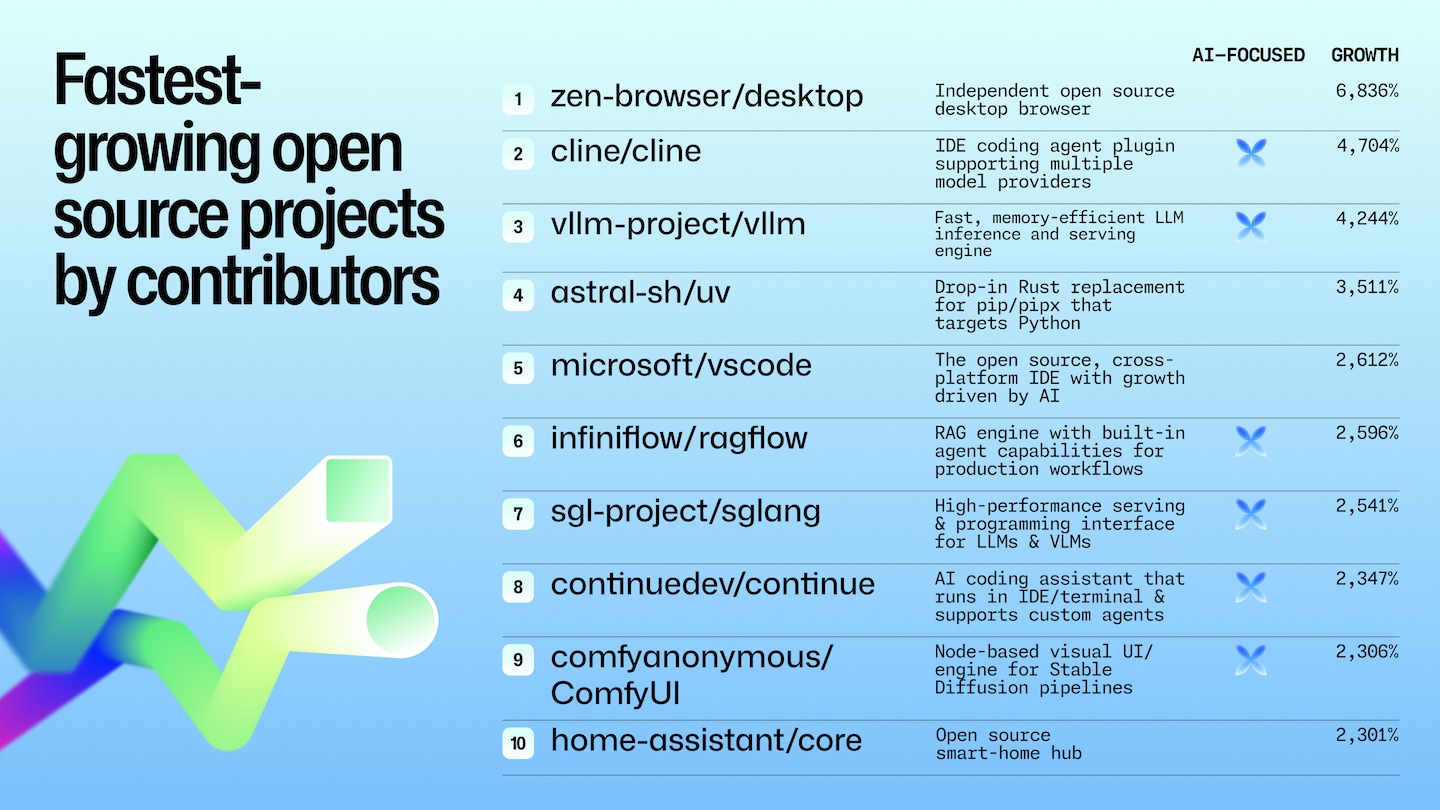
Just as the developer space is growing on a global scale, the same can be said about the projects that garner the most interest. These types of projects that support a global community and address their needs are going to continue to be popular and have the most support.
This just continues to reinforce how open source is really embracing being a global phenomenon as opposed to a local one.
What this year will likely hold
Open source in 2026 won’t be defined by a single trend that emerged over 2025. Instead, it will be shaped by how the community responds to the pressures identified over the last year, particularly with the surge in AI and an explosively growing global community.
For developers, this means that it’s important to invest in processes as much as code. Open source is scaling in ways that would have been impossible to imagine a decade ago, and the important question going forward isn’t how much it will grow—it’s how can you make that growth sustainable.
Tags:
Written by

Related posts

Rethinking open source mentorship in the AI era
As contribution volume grows, mentorship signals are harder to read. The 3 Cs framework helps maintainers mentor more strategically… without burning out.
Investing in the people shaping open source and securing the future together
See how GitHub is investing in open source security funding maintainers, partnering with Alpha-Omega, and expanding access to help reduce burden and strengthen software supply chains.

How to scan for vulnerabilities with GitHub Security Lab’s open source AI-powered framework
GitHub Security Lab Taskflow Agent is very effective at finding Auth Bypasses, IDORs, Token Leaks, and other high-impact vulnerabilities.