GitHub’s RubyGem Server
Update regarding require, please read below The next time you visit your repository’s edit screen you’ll see a new checkbox that should be pretty exciting for users hosting their RubyGem…
Update regarding require, please read below
The next time you visit your repository’s edit screen you’ll see a new checkbox that should be pretty exciting for users hosting their RubyGem project on GitHub:
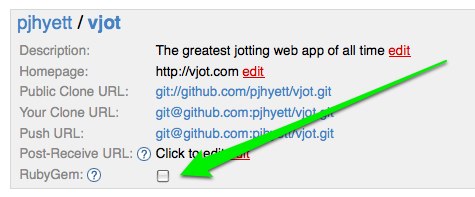
After checking that, managing your gem is as simple as managing a gemspec in your project’s root directory (example). Anytime you push a modified gemspec to GitHub, we’ll build and publish a new gem for you.
Feel free to give your open source friends a hard time when they don’t release a new gem version for a while, because they have no excuse now 🙂
One concept regarding our server that bears repeating is that your gem will always be prefixed with your username. Installing mojombo’s grit gem is done via the following:
$ sudo gem install mojombo-grit
Successfully installed mojombo-grit-0.8.1
Using said gem works a couple of ways. First the regular require:
$ irb -rubygems
>> require 'grit'
=> true
Update: The following also works if you have competing versions of the same gem:
$ irb -rubygems
>> gem 'mojombo-grit'
=> true
>> require 'grit'
=> true
The namespacing may feel awkward as first, but it really lends itself to the distributed nature of the service we provide. Forking a RubyGem project shouldn’t be any more complicated than forking any other type of project.
Visit http://gems.github.com for all of the details. Enjoy!
Written by

Related posts
10 technical talks I’m excited about at GitHub Universe 2026
From verifying AI-written code to securing npm dependencies, these are the sessions I’m building my Universe agenda around.

Developer policy update: Transparency, state policy, and what’s ahead
Explore GitHub’s latest transparency data and learn more about policy updates affecting developers and open source.

Developers want more efficient software. Here’s what over 1,000 GitHub users told us they need.
New research from GitHub and Yale Program on Climate Change Communication finds strong demand for tools, measurement, and practical guidance that can help developers reduce wasted compute.