Search Syntax Improvements
Today we are announcing simplified syntax for adding comparison and range criteria to searches. Previously we relied on Solr-style syntax, so searching for items with more than 10 stars would…
Today we are announcing simplified syntax for adding comparison and range
criteria to searches. Previously we relied on Solr-style syntax, so searching
for items with more than 10 stars would look like stars:[10 TO *]. The new
syntax simplifies this to stars:>10.
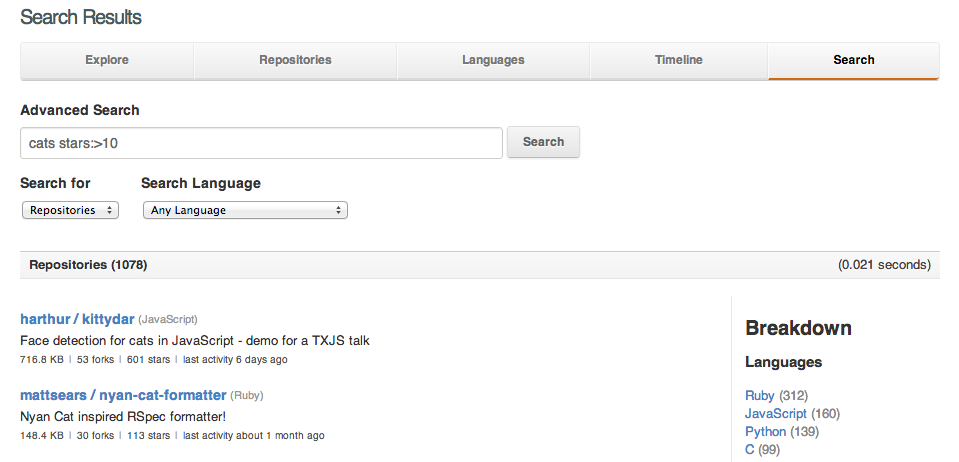
Greater Than Queries
Let’s find all repositories that have something to do with “cats”, and that
have been starred 10 or more times by other GitHub users. All the following
search examples are equivalent:
Less Than Queries
What about if we are interested in the less popular “cats” repositories?
We can find them using the new syntax as well:
Range Queries
Our search updates also improve the syntax for range queries. Say we’re looking
for “cats” repositories that were last updated between the end of April and July 4th
of 2012. Using the new syntax this would look like:
Omitting Spaces
If you prefer a more compact notation and typing fewer characters, you can
omit the quotations and the space characters for any of these range criteria.
Quotations need to be included only if the range value contains whitespace.
Written by

Related posts

GitHub availability report: August 2026
In August, we experienced five incidents that resulted in degraded performance across GitHub services.

The August 17 outage, and the work ahead
An update on the August 17 outage and the steps we’re taking to improve reliability.

Your guide to GitHub Universe 2026 is here: The schedule just launched!
The GitHub Universe session catalog is live. Explore interactive workshops, community talks, demos, and panels. Plus, register before August 19 to save $300.