Art of play in the age of AI
Now that code ships faster than ever, you have more time to spend on projects just for the fun of it. Here’s what we can learn through that process as developers.
As kids, we spent hours tinkering and building and just messing with things. As an adult, I could watch my own young kiddos figure out how certain shapes and movement work all day. Through that play, we improved our problem-solving and language skills, and it’s probably not a stretch to say it was good for our early engineering skills.
In this era of development now, we’re starting to get a taste of that again. We’re experimenting more, and taking in more changes, because it’s all new!
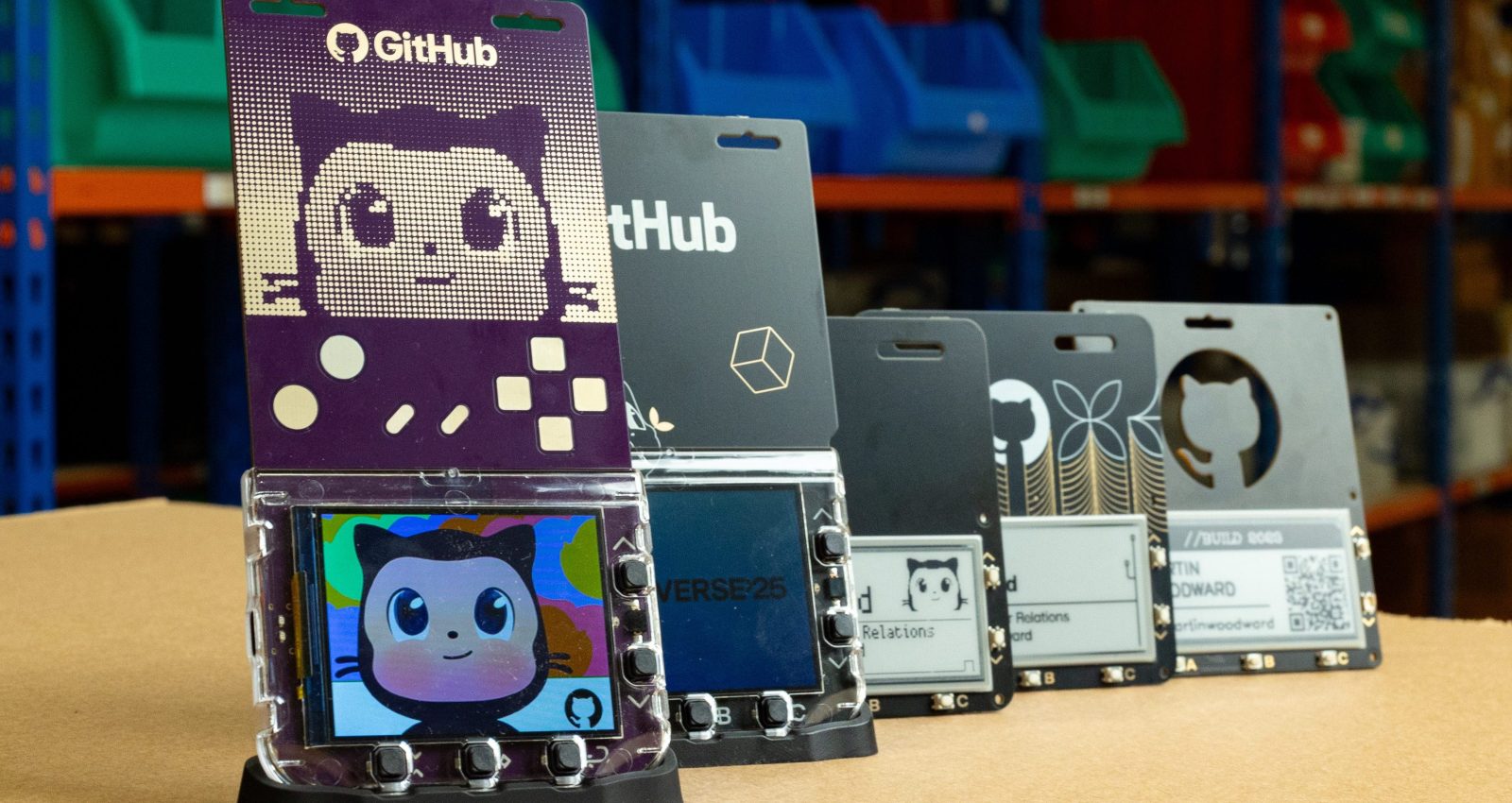
For the last four years at GitHub Universe, we’ve had hackable conference badges. What started as a simple e-ink display for your name and job title morphed into a labor of love for Martin Woodward, VP of Developer Relations. This year, the badge evolved into a device with a color screen, rechargeable battery, accelerometer sensors, and touch-sensitive gaming controls.
The tinkering we’ve seen with the badges has been amazing.
Hacking the GitHub Universe Badge with these 3 apps that I made!! #GitHubUniverse https://t.co/Qy5wYPqXf5
— Connie Xu (@conniecodes) October 28, 2026
you can play octo drive on your @github universe badge! repo - https://t.co/DrYkhjvMVt https://t.co/S6jVwxPdEY
— Rishab Kumar (@rishabincloud) October 27, 2026
Coding needs room for play
According to the Octoverse report, 40% of pull requests were started by agents by September. That’s a big jump from the 17% we saw in March, which was already a pretty high number.
With that kind of pace of change, it’s easy to feel unsteady thinking about our coding skills that we’ve been honing as an industry for decades. At the same time, one might argue that the tools and changes in front of us offer more room for experimentation and creativity!
AI can turn our ideas into working code faster than ever before. We can build things just because we’re curious to see if it’ll work, without the burden of figuring out every single step before getting started. The learning is moving to different parts of the building timeline.
As Martin said in our GitHub Podcast episode, “Give yourself permission to play, call it learning,” but with the caveat that you should time-box it so that you don’t spend too much time perfecting it. Know when to stop, ship, and share.
You don’t need a big idea to start
What’s really exciting is how the scope of projects have changed. With AI tooling, we don’t have to build with everyone in mind every time (not that we necessarily did before, but it was definitely a default mindset for the industry). We can build things way more often for our exact use cases. It could “just work on my machine” and be feature-complete!
At the GitHub Universe closing keynote, Martin wanted to teach himself machine learning, so he built himself a pedometer onto his conference badge. He used Copilot to collect movement data from the badge’s accelerometer, trained a simple machine-learning model in his browser, and deployed it to the badge. Then he walked around to test whether it could tell the difference between walking, standing still, and fidgeting.
Imagine just a year or two ago wanting to dabble with machine learning. You totally could have! But for the average developer, that’s a daunting task. The barrier to entry for so many tougher concepts has gotten lower, and that means more people can experiment and have fun with any device they can think of, from a conference badge to a smart picture frame to a home TV.
AI with oversight
AI is top of mind all the time right now, but you are a part of the story, too.
In order to scale with AI, we need human judgement. We can see the AI tells in writing (“that’s the real unlock!”), in imagery (the fonts, man), or in code (commenting code blocks that have never been commented before). We need to keep the feedback loop, to be able to inspect, debug, and test what the agent produced, and to make whatever we’re building our own.
Be kind, keep maintainers in mind
It’s really fun to share your experiments with the world, but contributing to existing open source projects take a bit more consideration than that. Both our podcast episode and the keynote addressed this. We’re seeing maintainers get absolutely hammered with AI-powered contributions to their repositories, which adds a lot to the maintenance burden.
Efforts need to be made by all of us, like the one shared here, to help ease burdens for maintainers.
As Martin explained in the keynote, “Open source is the freedom to inspect, to remix, and to share without asking for permission. But it’s not the freedom to impose your will on others.”
Forking a repository gives you room to explore your own ideas, and there’s a really fun, exciting power in that. But before you impose those ideas on others and send them to the main repository, make sure you:
- Read the contribution guidelines
- Check existing issues
- Understand what the project needs
Respecting that work helps keep open source manageable (and even enjoyable) for the people looking after it.
Now it’s your turn
We answered the perennial question on our badge, “But can it run Doom?” Why yes, yes it does. Give it a go on our virtual badge, and try tinkering on it yourself.
Then get your hands on your own badge. We made some extra badges just for you. Order yours today, then tell us what you’ll be building. Plus, use code FREESHIPBLOG26 for free standard shipping through December 1, 2026.
Tags:


Related posts

These are the gifts developers will actually want
The developer you’re shopping for hasn’t shared their holiday wish list with you yet? Check out these gifts, plus our Black Friday discount all week long.

GitHub availability report: October 2026
In October, we experienced eight incidents that resulted in degraded performance across GitHub services.
GitHub Universe 2026: Evolving every layer of the stack
Today, we laid out our vision for GitHub as the most comprehensive, end-to-end software delivery system in the world.