Looking to stay one step ahead? Read the latest Octoverse report and try the Copilot usage metrics dashboard.
Home / AI & ML / Generative AI
How AI is reshaping developer choice (and Octoverse data proves it)
AI is rewiring developer preferences through convenience loops. Octoverse 2025 reveals how AI compatibility is becoming the new standard for technology choice.

|
6 minutes
You know that feeling when a sensory trigger instantly pulls you back to a moment in your life? For me, it’s Icy Hot. One whiff and I’m back to 5 a.m. formation time in the army. My shoulders tense. My body remembers. It’s not logical. It’s just how memory works. We build strong associations between experiences and cues around them. Those patterns get encoded and guide our behavior long after the moment passes.
That same pattern is happening across the software ecosystem as AI becomes a default part of how we build. For example, we form associations between convenience and specific technologies. Those loops influence what developers reach for, what they choose to learn, and ultimately, which technologies gain momentum.
Octoverse 2025 data illustrates this in real time. And it’s not subtle.
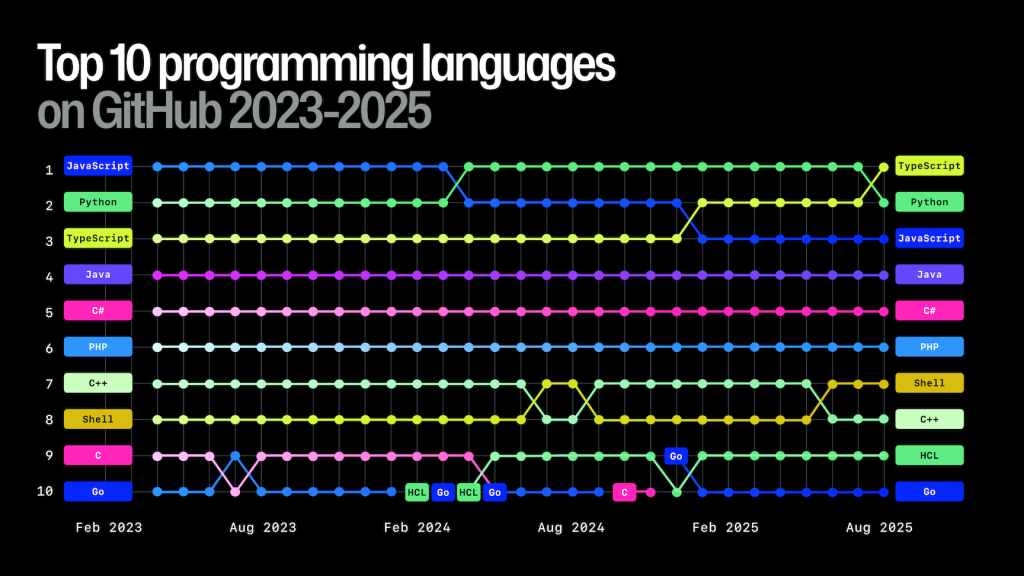
In August 2025, TypeScript surpassed both Python and JavaScript to become the most-used language on GitHub for the first time ever. That’s the headline. But the deeper story is what it signals: AI isn’t just speeding up coding. It’s reshaping which languages, frameworks, and tools developers choose in the first place.
The convenience loop is how memory becomes behavior
When a task or process goes smoothly, your brain remembers. Convenience captures attention. Reduced friction becomes a preference—and preferences at scale can shift ecosystems.
Eighty percent of new developers on GitHub use Copilot within their first week. Those early exposures reset the baseline for what “easy” means.
When AI handles boilerplate and error-prone syntax, the penalty for choosing powerful but complex languages disappears. Developers stop avoiding tools with high overhead and start picking based on utility instead. The language adoption data shows this behavioral shift:
- TypeScript grew 66% year-over-year
- JavaScript grew 24%
- Shell scripting usage in AI-generated projects jumped 206%
That last one matters. We didn’t suddenly love Bash. AI absorbed the friction that made shell scripting painful. So now we use the right tool for the job without the usual cost.
This is what Octoverse is really showing us: developer choice is shifting toward technologies that work best with the tools we’re already using.
The technical reason behind the shift
There are concrete, technical reasons AI performs better with strongly typed languages.
Strongly typed languages give AI much clearer constraints. In JavaScript, a variable could be anything. In TypeScript, declaring x: string immediately eliminates all non-string operations. That constraint matters. Constraints help AI generate more reliable, contextually correct code. And developers respond to that reliability.
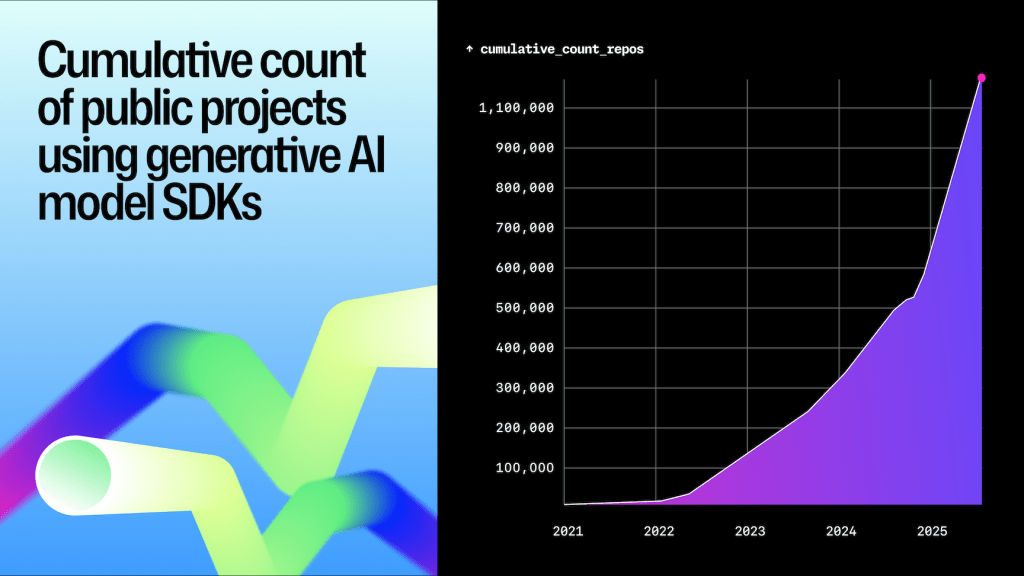
That effect compounds when you look at AI model integration across GitHub. Over 1.1 million public repositories now use LLM SDKs. This is mainstream adoption, not fringe experimentation. And it’s concentrating around the languages and frameworks that work best with AI.
Moving fast without breaking your architecture
AI tools are amplifying developer productivity in ways we haven’t seen before. The question is how to use them strategically. The teams getting the best results aren’t fighting the convenience loop. They’re designing their workflows to harness it while maintaining the architectural standards that matter.
For developers and teams
Establish patterns before you generate. AI is fantastic at following established patterns, but struggles to invent them cleanly. If you define your first few endpoints or components with strong structure, Copilot will follow those patterns. Good foundations scale. Weak ones get amplified.
Use type systems as guardrails, not crutches. TypeScript reduces errors, but passing type checks isn’t the same as expressing correct business logic. Use types to bound the space of valid code, not as your primary correctness signal.
Test AI-generated code harder, not less. There’s a temptation to trust AI output because it “looks right” and passes initial checks. Resist that. Don’t skip testing.
For engineering leaders
Recognize the velocity jump and prepare for its costs. AI-assisted development often produces a 20–30 percent increase in throughput. That’s a win. But higher throughput means architectural drift can accumulate faster without the right guardrails.
Standardize before you scale. Document patterns. Publish template repositories. Make your architectural decisions explicit. AI tools will mirror whatever structures they see.
Track what AI is generating, not just how much. The Copilot usage metrics dashboard (now in public preview for Enterprise) lets you see beyond acceptance rates. You can track daily and weekly active users, agent adoption percentages, lines of code added and deleted, and language and model usage patterns across your organization. The dashboard answers a critical question: how well are teams using AI?
Use these metrics to identify patterns. If you’re seeing high agent adoption but code quality issues in certain teams, that’s a signal those teams need better prompt engineering training or stricter review standards. If specific languages or models correlate with higher defect rates, that’s data you can act on. The API provides user-level granularity for deeper analysis, so you can build custom dashboards that track the metrics that matter most to your organization.
Invest in architectural review capacity. As developers become more productive, senior engineering time becomes more valuable, not less. Someone must ensure the system remains coherent as more code lands faster.
Make architectural decisions explicit and accessible. AI learns from context. ADRs, READMEs, comments, and well-structured repos all help AI generate code aligned with your design principles.
What the Octoverse 2025 findings mean for you
The technology choices you make today are shaped by forces you may not notice: convenience, habit, AI-assisted flow, and how much friction each stack introduces..
💡 Pro tip: Look at the last three technology decisions you made. Language for a new project, framework for a feature, tool for your workflow. How much did AI tooling support factor into those choices? If the answer is “not much,” I’d bet it factored in more than you realized.
AI isn’t just changing how fast we code. It’s reshaping the ecosystem around which tools work best with which languages. Once those patterns set in, reversing them becomes difficult.
If you’re choosing technologies without considering AI compatibility, you’re setting yourself up for future friction. If you’re building languages or frameworks, AI support can’t be an afterthought.
Here’s a challenge
Next time you start a project, notice which technologies feel “natural” to reach for. Notice when AI suggestions feel effortless and when they don’t. Those moments of friction and flow are encoding your future preferences right now.
Are you choosing your tools consciously, or are your tools choosing themselves through the path of least resistance?
We’re all forming our digital “Icy Hot” moments. The trick is being aware of them.
Tags:
Written by

Related posts

Agent-driven development in Copilot Applied Science
I used coding agents to build agents that automated part of my job. Here’s what I learned about working better with coding agents.

Building AI-powered GitHub issue triage with the Copilot SDK
Learn how to integrate the Copilot SDK into a React Native app to generate AI-powered issue summaries, with production patterns for graceful degradation and caching.

How Squad runs coordinated AI agents inside your repository
An inside look at repository-native orchestration with GitHub Copilot and the design patterns behind multi-agent workflows that stay inspectable, predictable, and collaborative.