Updates to protected branches
Automatically enforce protected branch settings across multiple branches in your repository.

Protected branches make sure the right reviews happen, support passing CI, and prevent force pushes. With our latest update, you can automatically enforce protected branch settings across multiple branches in your repository.
If you’re a repository owner or have admin permissions in a repository, you can now customize branch protections and enforce certain workflows, such as requiring more than one pull request review or requiring certain status checks to pass before allowing a pull request to merge.
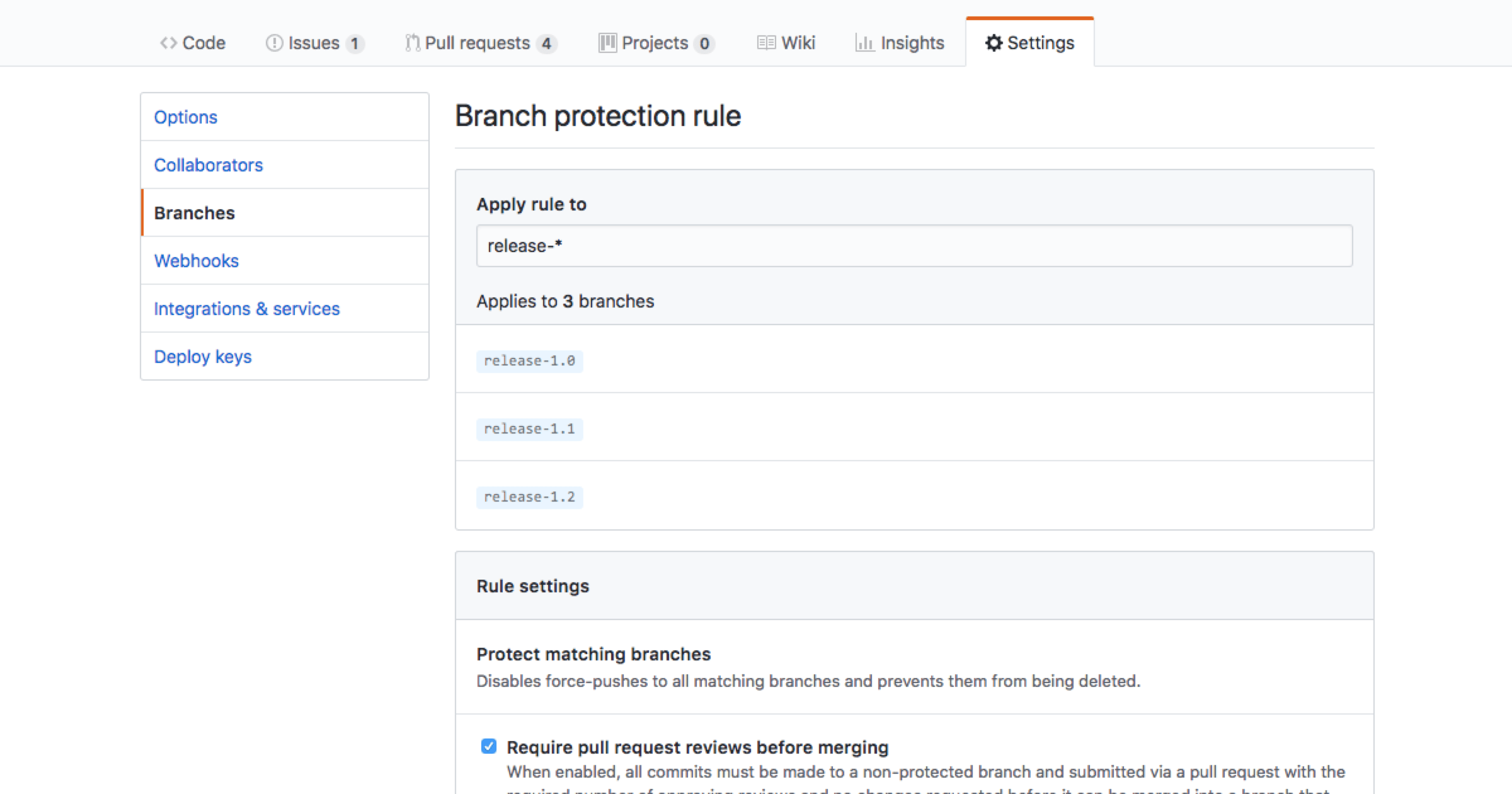
Branch protection rules
Branch protection rules build on our existing branch protection functionality. Instead of setting up individual protections for multiple branches, you can share the same set of protections across different branches matching the same naming pattern.
Branch protection rule patterns are based on fnmatch syntax. You could use releases/v?.? to automatically protect branches like releases/v1.0, releases/v2.0, and releases/v2.1. And [1-9]-[0-9]-stable could automatically protect branches like 1-0-stable, 2-0-stable, and 2-1-stable.
View more fnmatch documentation or learn more about configuring protected branches.
Written by

Related posts

Why age assurance laws matter for developers
Youth safety requirements are moving down the tech stack to operating systems and app stores—raising new questions for open source developers.

How researchers are using GitHub Innovation Graph data to reveal the “digital complexity” of nations
Researchers share in an interview how they used GitHub data to predict GDP, inequality, and emissions in ways that traditional economic data misses, along with our Q4 2025 data release.

An update on GitHub availability
Here’s what we’ve done—and what we’re still doing—to improve our availability and reliability.