GitHub Desktop 1.1 is now available
A fresh release of our Electron app is ready for your desktop. GitHub Desktop 1.1 builds on last year’s Electron relaunch with new features and enhancements that help you bring…
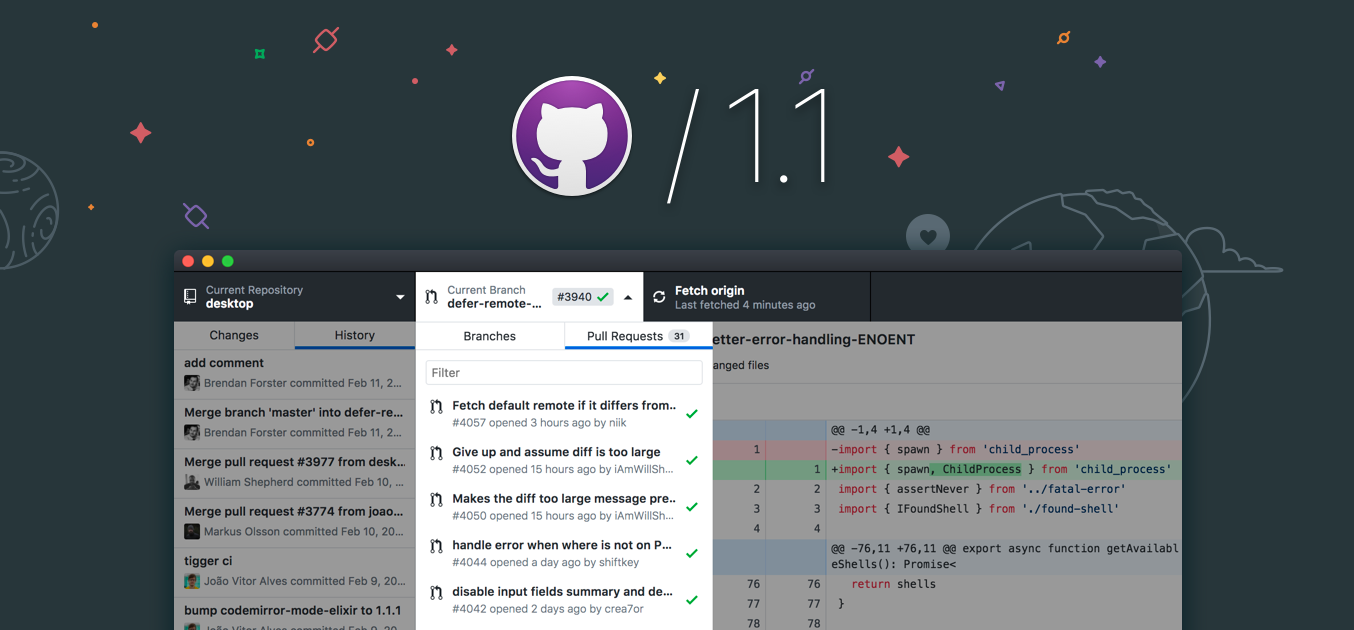
A fresh release of our Electron app is ready for your desktop. GitHub Desktop 1.1 builds on last year’s Electron relaunch with new features and enhancements that help you bring even more GitHub workflows to your desktop.
Pull request list
The branch selector now displays open pull requests alongside the branches for the current repository. This makes it easy to check out a pull request as if it were a local branch. GitHub Desktop handles all the rote work necessary to work with the pull request, including adding the remote and setting the upstream branch so that you can keep up with changes to the pull request over time.

Commit status integration
Quickly see which pull requests pass commit status checks and which need more work. You can see if a pull request is passing from the list view or when the current branch has a pull request open.
Co-authoring commits
This release complements the co-author feature released a few weeks ago and makes it easy to add your collaborators as co-authors when you commit.

If you work on code with other developers, adding a co-author is a simple and effective way to share credit for your work without having to add a description or find out a teammate’s email.
Syntax highlighting in diffs
GitHub Desktop now supports syntax highlighting when viewing diffs for a variety of different languages.

Community involvement
GitHub Desktop is open source, and thanks to the community we’ve merged 62 contributions from 32 different contributors since 1.0 to fix bugs, improve existing features, and extend Desktop. Check out our release notes to see more details about these contributions.
Tags:
Written by

Related posts
GitHub Universe 2026: Evolving every layer of the stack
Today, we laid out our vision for GitHub as the most comprehensive, end-to-end software delivery system in the world.
Octoverse: Commits, pushes, reach new highs in 2026 as developers build with agents
See how a record year of growth reached every industry, every field, and every kind of builder in the 2026 Octoverse report.
The next developer interface is ambient intelligence
AI, agents, voice, and physical controls are shifting software development from operating tools to expressing intent—and helping developers stay focused on building.